How to Prepare Your Yard for Lawn Aeration and Overseed

Lawn aeration in Omaha, Nebraska by EcoScapes Lawn Care

Autumn is synonymous with earthy tones, hoodies, and pumpkin-flavored sweets. It’s also well-known as the best time of the year to aerate and overseed your lawn.

After a scorching summer, all that cool weather translates to ideal growing conditions for your lawn. The most essential things to concentrate on in the fall are repairing any damage from July and August, preparing for the winter, and preparing your grass for a lush spring. There are several things you can do for your lawn this time of year, but none offer the many benefits of lawn aeration.

In this article, we are going to focus on preparing your lawn for aerating and overseeding.

At the very least once a year, your turf should be aerated and overseeded. Preparing your lawn for aeration and overseeding can help you finish the growing season strong and get your yard ready for next year.

Let’s take a look at the best ways to get your lawn ready for fall aeration.

3 Steps to Prepare for Fall Lawn Aeration and Overseeding in Omaha

There are a few things you can do to prepare your lawn for aeration and overseeding. To begin, mowing your grass at a lower height is strongly recommended. Then, any objects or buildings that may be in the way of the aerator should be marked, and finally, watering should be adjusted to ensure that the soil is neither too wet nor too dry.

Let’s go over the process in greater depth.

Step 1: Mow Your Lawn Shorter Than Usual

You should start mowing your grass a little shorter a few weeks before aeration and seed planting. Most grasses in Nebraska thrive when they are managed at a height of no less than 3 1/2 inches. However, in the fall, we recommend cutting your grass to a height of 3 inches or less.

There are two reasons why we advise homeowners to do so. For starters, shorter turf will make it easier for seed and fertilizer to reach the soil and make direct contact with it. Second, it is suggested that no mowing be done for at least three to four weeks following aerating and overseeding. Reducing the height of your grass can help you get better results when it’s aerated, and it’ll save you from having a forest outside your house as the grass grows in the days after.

It is preferable to lower the mower blades in phases rather than all at once to reduce the stress that the lower height may create. Cutting too much grass at once can be harmful to your lawn. Gradually lowering the mower blades over a period of a few weeks allows the grass to adjust to the decreased height.

Step 2: Adjust Your Watering Schedule

Watering your grass is a delicate job that is hard to master, especially when the weather changes often. Watering any cool-season grass over the summer months leading up to fall aeration and planting is critical for its health.

Aeration is difficult in hard and dry soils, and seed germination is nearly impossible. Before aerating your goal should be soft but not muddy or excessively mushy to walk on. Lawn aerators are very heavy and when there’s a lot of water in the yard, they can sink or cause ruts in the lawn.

Prepare your system to run three to five times a day after your seed is planted. Remember to moisten your fresh seed to ensure proper germination. Soaking can cause your seed to wash away.
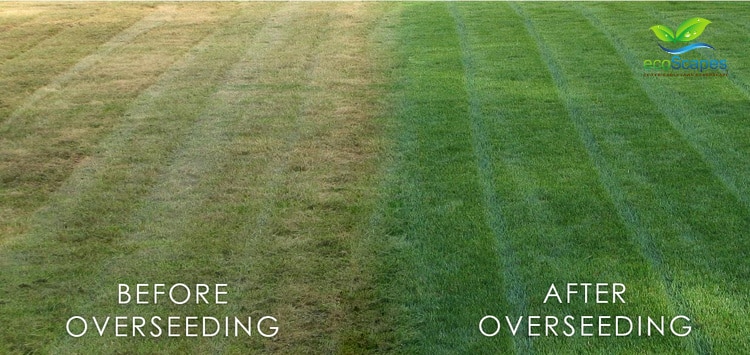
Lawn Overseeding in Omaha Nebraska by EcoScapes Lawn Care

Step 3: Flag Sprinkler Heads and any Obstacles

Because it is the only way to potentially avoid significant damage, this is arguably the most critical step in preparing your lawn for aeration.

Most core aerators penetrate the soil to a depth of three to five inches (depending on the moisture and nature of the soil). Because core aerators are strong and heavy equipment, any obstacles within five to six inches of the lawn’s surface may be damaged if not properly marked.

Most home supply stores provide flagging markers for marking your lawn.

Items linked with an irrigation system placed in the ground are one of the most typical obstacles in a lawn that need to be marked. Sprinkler heads, for example. Sprinkler heads are placed along the edge of the turf and possibly in the center of the lawn (it depends on the size of the lawn, as well as the layout of the irrigation zones). You must run each zone and set a flag next to the sprinkler heads to flag them. Sprinklers located within flowerbeds do not need to be marked. Only the objects that are within your yard’s perimeter. Take, for instance, a valve box.

Valve boxes are around the size of a plate and might be difficult to find. Check your lawn again, and any valve boxes you find should be marked on both sides.

Invisible fence lines for dogs (for dog training and keeping your pet in your yard), cables, wires, and pipelines are other items that should be marked. These may have been buried deep enough originally for and then revealed due to erosion. Underground dog fences, irrigation pipelines, lighting lines, and satellite cables are all examples of lines that can potentially be damaged.

Your lawn aeration and seeding provider cannot be held liable for any damages if they are unaware of a potential impediment on your lawn. If you’re having problems identifying these items in your yard, contact your lawn care provider in Omaha, and they may offer this as an extra service.

Aeration and overseeding in the early fall are crucial aspects of lawn upkeep, and there are actions that homeowners can do to ensure that the process goes well. Preparing for early fall aeration and overseeding may be accomplished by correct mowing, watering, and marking.

If you have any questions about how to prepare your lawn, contact our staff at EcoScapes Lawn Care.

How Much Does Lawn Aeration Cost in Omaha, NE

Lawn aeration near me by EcoScapes Lawn Care

By enhancing access to air, water, and nutrients, annual lawn aeration enables grass to produce strong, healthy roots. It’s a cost-effective strategy to assure a lush, healthy lawn, with prices ranging from $60 to $100 and up with a national average of roughly $130.

  • Range in Nebraska: $60 to $100 and up
  • National Average: $130


Aerating a lawn involves removing plugs of dirt to relieve soil compaction, allowing grass roots to spread out, grow stronger, and enhance the lawn’s health. Poking holes in the lawn with spikes or spraying a liquid aerating product over the lawn are two more options for aeration. The cost of aerating is relatively reasonable, and it is one of the best things you can do to keep a healthy lawn at a low cost when compared to other lawn management charges like installing a sprinkler system or having a tree removed.

The size of the lawn is the main factor affecting the cost—a lawn service may charge a base fee in addition to a square-footage price. Aerating a small lawn might cost as little as $60 on the low end, while aerating a large lawn may cost $300 or more.

Furthermore, the cost will vary based on the layout of the property and distance the company needs travel to reach the property. These hidden charges might increase (or decrease) the overall price.

How to Estimate the Cost of Lawn Aeration

A number of factors influence the cost of aerating a lawn, and in most situations, a representative from the company will want to inspect the site before providing a quote. You may aerate your lawn yourself by renting, purchasing, or spraying on a liquid aerator product, but for many people, it’s more cost effective to hire a professional lawn care service to do it.

  1. Consider the size of the lawn first when estimating the cost of aeration. Aeration costs roughly $0.006 to .012 per square foot on average. Multiply the square feet of your lawn by the price to obtain an estimate of how much aerating your lawn will cost.  Based on typical square foot pricing in Nebraska, if your lawn is 8,000 square feet, you can anticipate paying between $70 and $85.00.
  2. Inquire about fixed pricing. Some companies charge flat fees for standard-sized yards, which range from $65 to $95 on average, depending on the company. If the service is familiar with the location and the sizes of the yards in a particular development, a predetermined charge may frequently apply.
  3. Check to see if the business charges by the hour. Companies that bill by the hour are likely to set a minimum hourly rate, such as two hours, and then charge an hourly price after that. Whether the lawn is distinctive in some way—if it’s exceptionally steep or if there are other impediments in the way of the aeration process—a firm is more likely to charge by the hour. Hourly wages range from $50 to $85 per hour on average.
  4. You need to consider any extra services you’d want to have performed at the same time. Aeration is frequently conducted prior to overseeding a lawn, and by having both completed at the same time, you may be able to negotiate package pricing that is cheaper than if you had each service performed separately.
  5. You should also take into account travel time. A lawn care provider may have to travel from a neighboring community to individuals living in remote areas without professional lawn care, and the business may charge a trip fee.

You’ll have a fair notion of how much lawn aeration will cost once you’ve gathered all of the potential charges.

Contact us today for a free lawn aeration quote

Lawn aeration in Omaha by EcoScapes Lawn Care

Lawn Aeration Cost Calculation Factors

The cost of lawn aeration services varies greatly from one lawn to the next, depending on the size of your yard and where you reside. Consider the following aspects that will likely effect the ultimate cost while looking for low-cost options.

Location

The cost of living and the current rate of labor are influencing variables in lawn care services in any region. Because the cost of living is lower in rural areas, lawn services can be much less expensive than in big metropolises. Local taxes and company fees might also change, affecting the price since those costs—known as “overhead”—are passed on to the buyer.

Size of Lawn

In general, the larger the yard, the lower the cost per square foot for aerating. Lawn service businesses frequently charge by the square foot in increments. For example, having the first 1,500 square feet of grass aerated may cost $0.02 per square foot, then $0.01 per square foot for the next 10,000 square feet. When it comes to large yards (measured in acres), the overall cost per square foot will typically be significantly lower; anticipate paying between $150 and $250 per acre for aeration.

Preparation

To work effectively, aeration equipment requires a smooth, clean yard. There may be an additional service charge applied to the bill if the lawn care service needs to pick up bushels of dry leaves or take away fallen branches and debris. Learn more about preparing your yard for fall lawn aeration and overseed.

Slope

Because navigating steep slopes with a lawn aerator takes longer, expect to pay more for those areas to be aerated. If a significant portion of the lawn is sloping, lawn companies who normally charge a set cost may switch to a per-hour rate.

Method of Aeration Affects the Cost

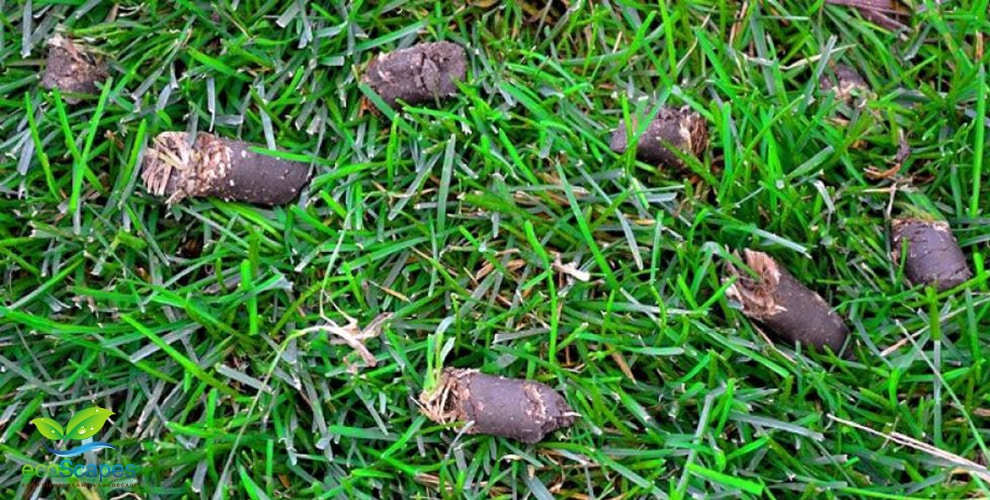
The cost of lawn aeration also varies depending on the method used by the service provider. Core aeration, which provides the most complete advantages, is the most expensive since it necessitates the use of a machine that extracts plugs from the soil and ejects them onto the surface of the grass. This necessitates a more complicated apparatus, resulting in a larger equipment investment. Spike aerators are less expensive and work on a simpler foundation than core aerators.

Liquid Lawn Aeration

Liquid lawn aeration entails spraying an enzyme-rich solution over the grass. At ground level, the enzymes begin degrading thatch, a thick coating of dead grass that accumulates at the base of the grass blades. Thatch obstructs airflow and decreases drainage. For a modest (5000 square foot) lawn, liquid aeration can cost as low as $45, or $0.009 per square foot. Liquid aeration is less expensive since it does not require heavy machinery, but it will not relieve soil compaction as well as core aeration.

Spike Aeration

Spike aeration involves putting 4- to 5-inch spikes into the existing ground to improve drainage, but unlike core aeration, no soil is removed. It is ideal for lawns with sandy soil, which doesn’t compress as much as clay-based soils. It costs more than liquid aeration but less than core aeration on average, with prices ranging from $55 to $110 for a 10,000-square-foot lawn.

Core Aeration

Because the equipment needed to dig and remove plugs from an existing lawn is generally more expensive than spike aeration or lawn-spraying equipment, the overall cost is greater, as seen by the average price increase of 15 to 25 percent above spike aeration.

How to Cut the Cost of Lawn Aeration

Because the equipment needed to dig and remove plugs from an existing lawn is generally more expensive than spike aeration or lawn-spraying equipment, the overall cost is greater, as seen by the average price increase of 15 to 25 percent above spike aeration.

How much does lawn aeration cost in Omaha, Nebraska

Having a healthy and green lawn shouldn’t break the bank—and it won’t if you keep up with lawn irrigation and upkeep. Keeping turf grass healthy is easier, and less expensive, than attempting to recover it if it’s weak or injured, so stick to a regular watering, mowing, and fertilizing plan. Annual lawn aeration is an additional cost to consider if you want to keep your grass looking green. Try these suggestions to get the most bang for your buck.

Obtain many estimates. Make it clear to the service that you’re searching for numerous estimates straight away. When a firm knows you’ll be contacting other businesses, they’ll be more inclined to give you a better price. Even if you’ve previously used the business, let them know you’re expecting their best pricing and that you’re collecting other quotes.

Make an all-inclusive offer. If a client is eager to hire them for more projects, it makes sense for businesses to reduce their rates on certain services. By negotiating an agreement with the company for continuing lawn maintenance, such as mowing, tree trimming, and overseeding, you may be able to save up to 20% or more off the normal price of lawn aeration.

Specials may be found on the company’s website. Lawn care providers are always looking for new clients, and their website is a fantastic location to look for discounts. Limited-time promotions or introductory rates are popular during holidays such as Father’s Day, Independence Day, and Memorial Day. You might be able to discover printable discounts or save money by booking a lawn care service online.